
Transfer Experience
Turning Waiting into Discovery
This project was developed in a service design course, where the task was to create a future mobility service.
While many concepts focused on speed, efficiency, and speculative technologies such as flying taxis or advanced car-sharing, I deliberately shifted the perspective.
Instead of asking how to get from A to B faster, I reframed the question:
How can the journey itself become meaningful?
I directed the team’s focus toward an often overlooked part of mobility: the railway.
Trains are one of the most sustainable modes of transport, yet the experience around them, especially outside the actual ride, often feels inefficient or unpleasant.
Initial ideas explored enhancing the train journey itself, for example through social interaction between passengers. However, user research revealed something unexpected.

Affinity Diagraming
Contrary to our assumptions, most participants did not want additional services during the train ride. Train travel was perceived as calm and even enjoyable. The real problem appeared during transfers. Waiting times between connections were described as stressful, boring, or wasted. Many users preferred to stay close to the platform out of fear of missing their train or losing their luggage.
This insight became the foundation of the concept.
Instead of optimizing the train ride, we focused on transforming the transfer itself.
The core idea was simple: what if waiting time could be used to briefly explore a city? What if a necessary interruption in the journey became a small, meaningful experience?
The result is Transfer Experience, a service that turns transfers into spontaneous micro-trips. As one guiding principle summarizes:

“This service does not save time — it creates time.”

The service unfolds through a sequence of touchpoints designed around human needs: curiosity, security, and autonomy.

Onboarding and Route Selection
The experience begins at the station. Travelers encounter the service through existing railway touchpoints such as ticket booking, posters in trains, or signage at the platform. A simplified flyer version ensures accessibility even without a smartphone, while also acting as an entry point via QR code.
Once installed, the app immediately creates a sense of anticipation. Large, inviting visuals and short descriptions highlight possible routes based on personal interests such as culture, food, or shopping. At the same time, the system builds trust by clearly communicating that it understands the user’s travel plan and will manage timing and logistics in the background. Remaining time is always visible, even outside the app.
Luggage Service
The first key interaction is the luggage service. When the user opens the map for the first time, they are prompted to hand over their baggage. This moment is central to the experience. Luggage is one of the main psychological barriers during transfers: it limits mobility and creates constant stress.
By removing this burden, the service enables real freedom. Users can move through the city without hesitation, knowing their belongings are handled safely. At the same time, the system reinforces security by adapting to the infrastructure of each station, whether through lockers or staffed services.


Navigation
From here, the user enters the exploration phase. Navigation is intentionally designed as a suggestion, not a restriction. Users can follow a proposed route, create their own, or simply wander. Locations can be added or removed dynamically, and deviations are not corrected but supported. The system recalculates routes and suggests new points of interest along the way.
This flexibility reinforces autonomy while maintaining orientation. To reduce screen dependency, the service includes optional audio guidance. Users can put their phone away and experience the city more directly, while still receiving navigation and contextual information.
Location Details
When arriving at locations, the app provides short, engaging insights—historical facts, cultural context, and nearby recommendations. The goal is not to overwhelm, but to stimulate curiosity. The main experience remains the city itself.
To support short transfer times, the concept also considers partnerships with local businesses. Museums could offer short-visit tickets, restaurants could provide fast-service menus, and bookings could be handled directly through the app. This allows users to make the most of limited time without friction.

Rebooking
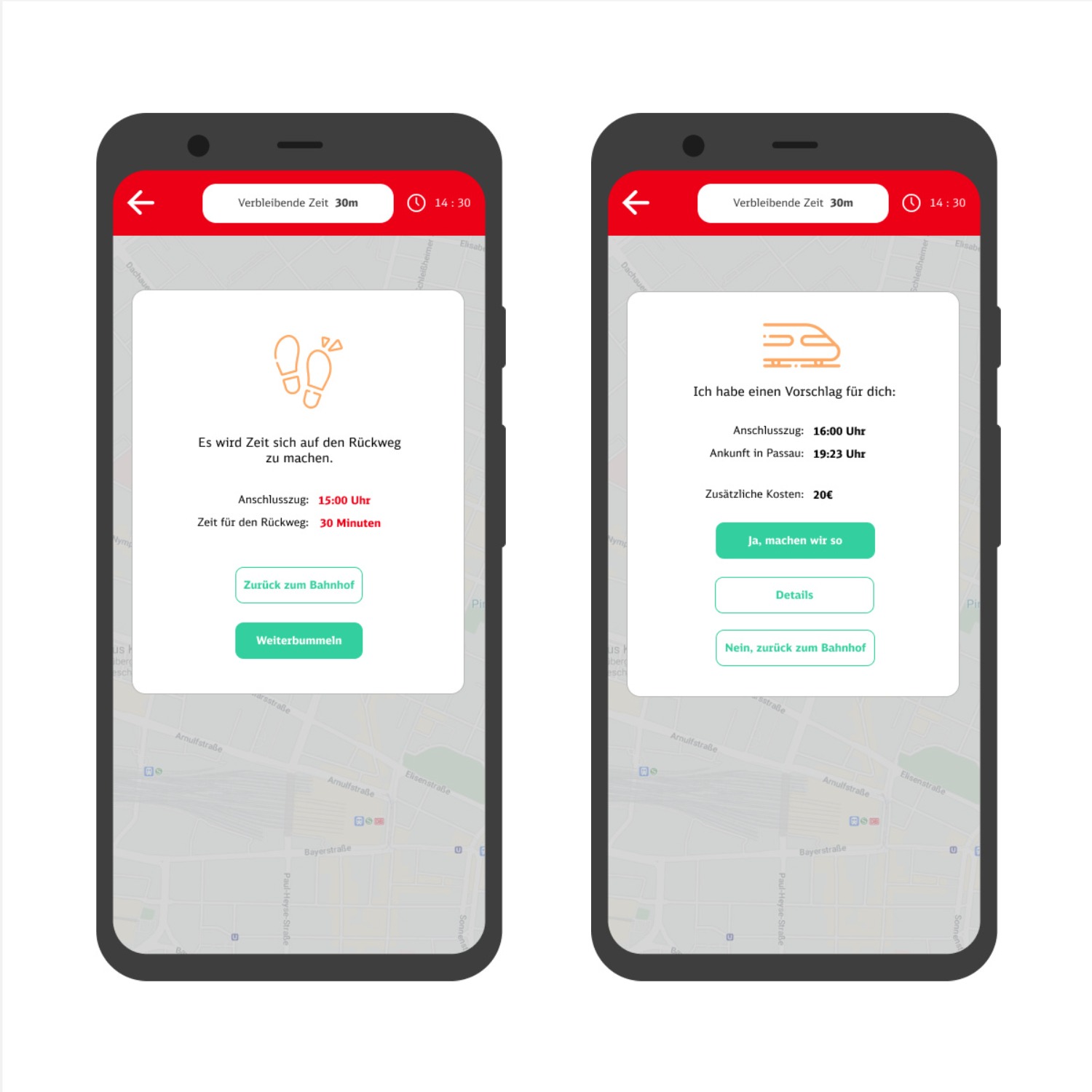
A defining feature of the service is its approach to time management. As the transfer progresses, the system gently reminds the user when it is time to return. However, this is not framed as pressure, but as an option.
If the user wants to continue exploring, they can rebook their connection directly within the app. The interface avoids the stress typically associated with missed trains. Instead of complex lists of alternatives, it offers a clear and calm suggestion that fits the experience, allowing the user to stay immersed.
Luggage Return
The journey concludes with a smooth return to the station. The user is guided back, and the luggage service seamlessly reintegrates. Depending on the station, baggage is either delivered directly to the platform or collected at a designated point. Notifications ensure that the user always feels in control of timing.

Once back on the train, the experience can optionally continue through reflection—reviewing the tour, saving highlights, or sharing impressions.
Beyond the individual user, the service creates value for multiple stakeholders.
Cities benefit from increased micro-tourism, local businesses gain new customers, and the railway becomes more attractive as a travel option. In the long term, this approach could encourage new forms of sustainable tourism, where journeys are intentionally interrupted to explore multiple locations.
What makes this project particularly relevant for my work is its strong focus on human needs. Instead of optimizing for efficiency alone, the service is built around stimulation, security, and autonomy. It demonstrates how reframing a problem: seeing waiting time not as a loss, but as an opportunity, can lead to entirely new service concepts.